Specs that keep up
with your code.
Keep requirements, evidence, and design intent in your repo: versioned, verified, and queryable by your team and your agents.
The problem
Software change needs a
contract layer.
Specs drift outside the repo
Requirements in wikis and tickets stop being enforceable the moment code moves. If the spec is not versioned and checked with the code, drift becomes invisible.
Specs are invisible until something breaks
Plain-text specs give no feedback. You don't see what's verified, what's stale, or what's missing until a bug reveals it. There's no status at a glance.
Agents need machine-readable contracts
AI coding workflows move quickly, but prompts are not a control plane. Agents need structured scope, explicit criteria, and a way to check what changed.
How it works
Write the contract. See it come alive.
Write criteria in Markdown, verify structural integrity in the terminal, and see live status in your editor preview.
---
supersigil:
  id: auth/req/login
  type: requirement
  status: approved
---

# User Authentication

```supersigil-xml
<AcceptanceCriteria>
  <Criterion id="valid-creds">
    WHEN a user submits valid credentials
    THE SYSTEM SHALL issue a session token
    within 200ms.
  </Criterion>

  <Criterion id="invalid-creds">
    WHEN a user submits invalid credentials
    THE SYSTEM SHALL return a 401 response
    with a generic error message.
  </Criterion>
</AcceptanceCriteria>
```$ supersigil verify
auth/req/login
✖ [missing_verification_evidence]
Criterion "invalid-creds": no matching evidence
note:
1 document affected by 1 changed file. Run supersigil affected --since main
1 error, 1 warning across 3 documentsvalid-creds WHEN a user submits valid credentials THE SYSTEM SHALL issue a session token within 200ms
test_session_issued_for_valid_creds tests/auth/login.rs:28 invalid-creds WHEN a user submits invalid credentials THE SYSTEM SHALL return a 401 response with a generic error message
Core Strengths
The contract layer between intent,
code, and delivery.
One graph for requirements, designs, tasks, and evidence.
Every document becomes a typed node with computed reverse links. Evidence flows in through native Rust and Vitest support, tags, or file globs. Query any slice with the CLI or explore the graph interactively in your browser.
Structured scope for coding agents. Verified in CI.
Six agent skills ship with Supersigil, teaching agents the full spec-driven workflow: specification, implementation, refactoring, retroactive documentation, CI review, and end-to-end development. Agents load context, plan against criteria, and re-verify through the same CLI. supersigil verify checks the graph in CI, while tracked files flag specs that need review after code changes.
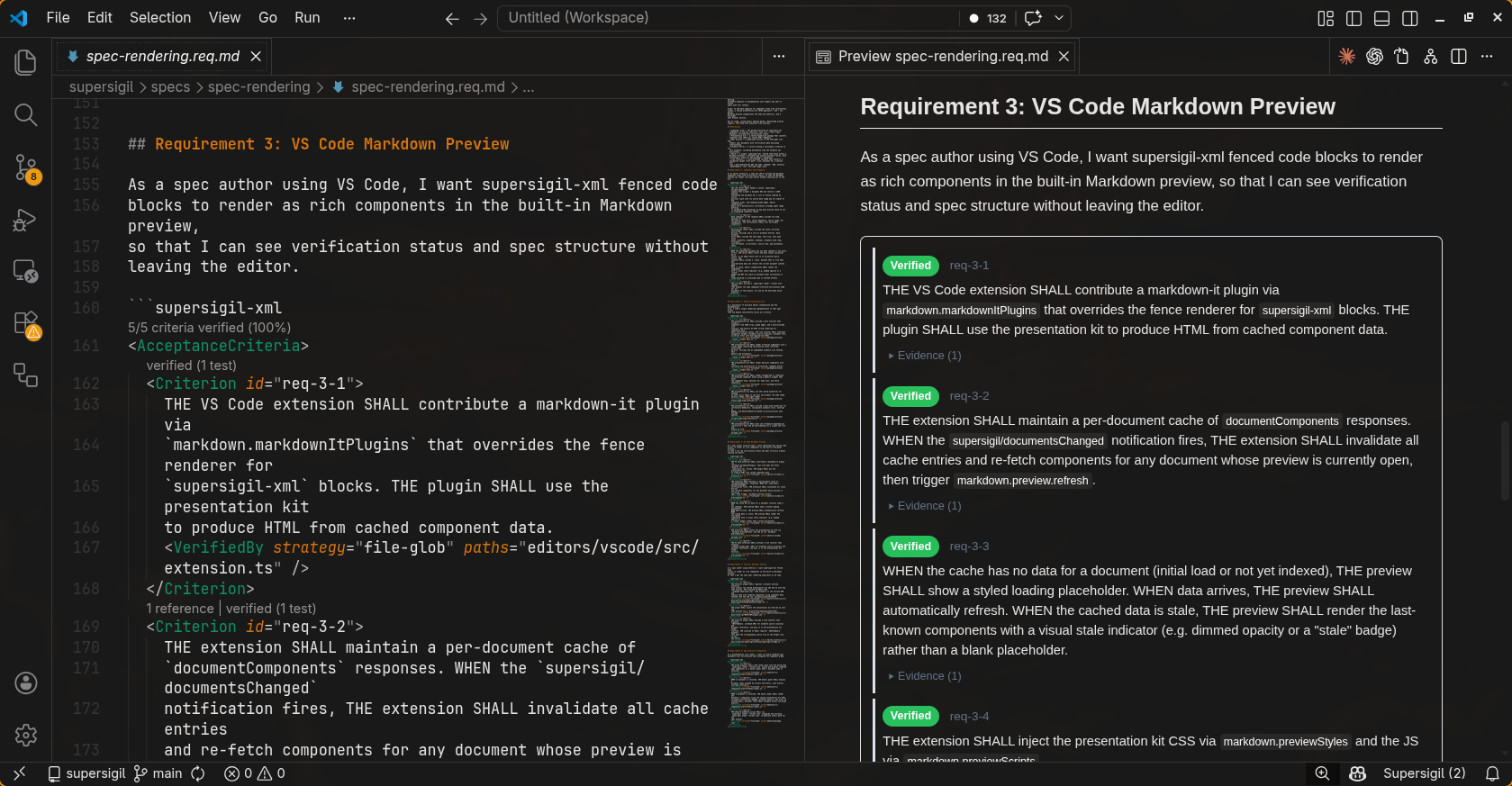
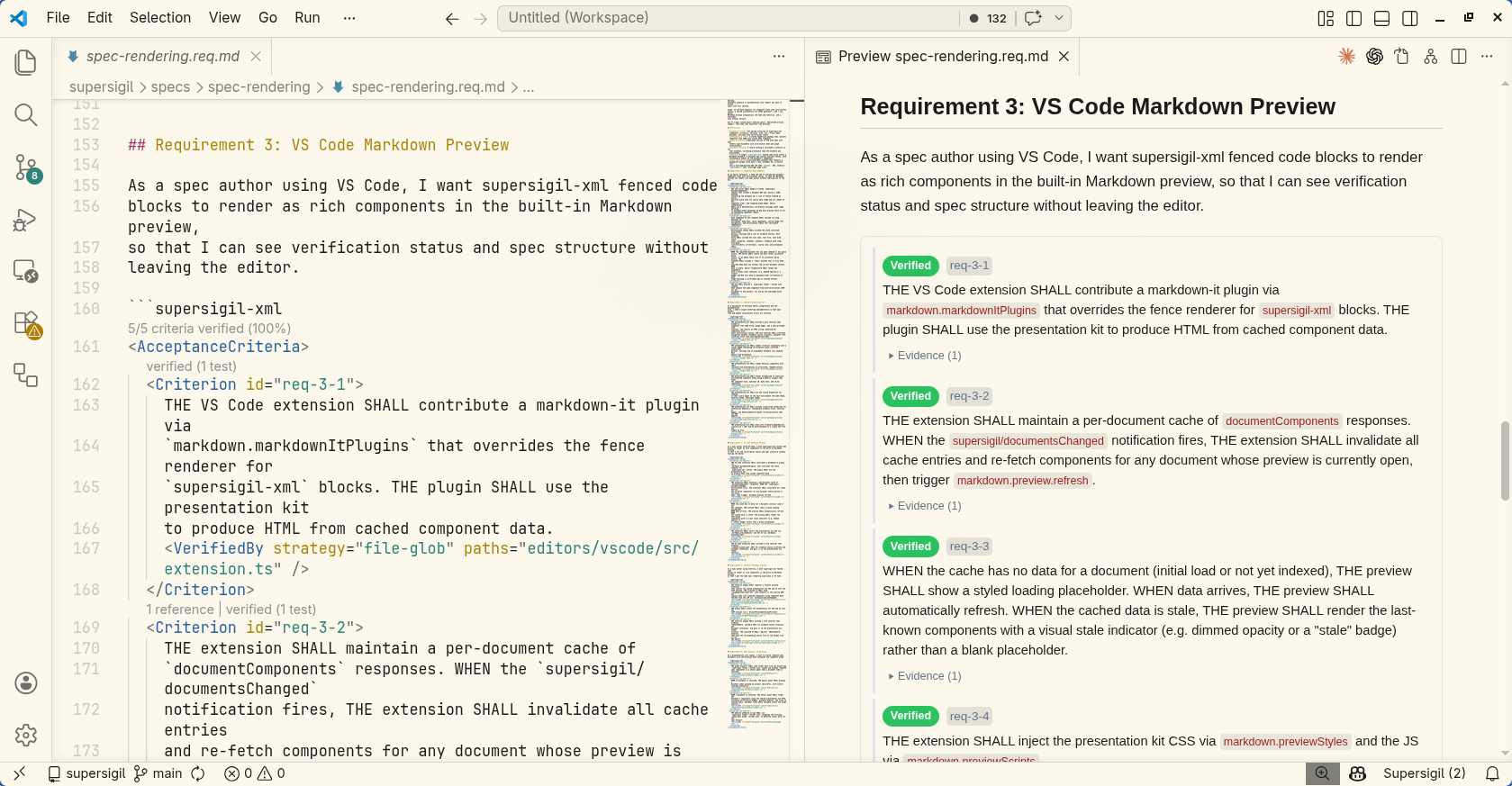
Specs rendered with live verification status.
VS Code and IntelliJ extensions render Markdown previews with verification badges, expandable evidence with test links, and navigation to related documents. Plus diagnostics, autocomplete, hover docs, and go-to-definition through the LSP server.
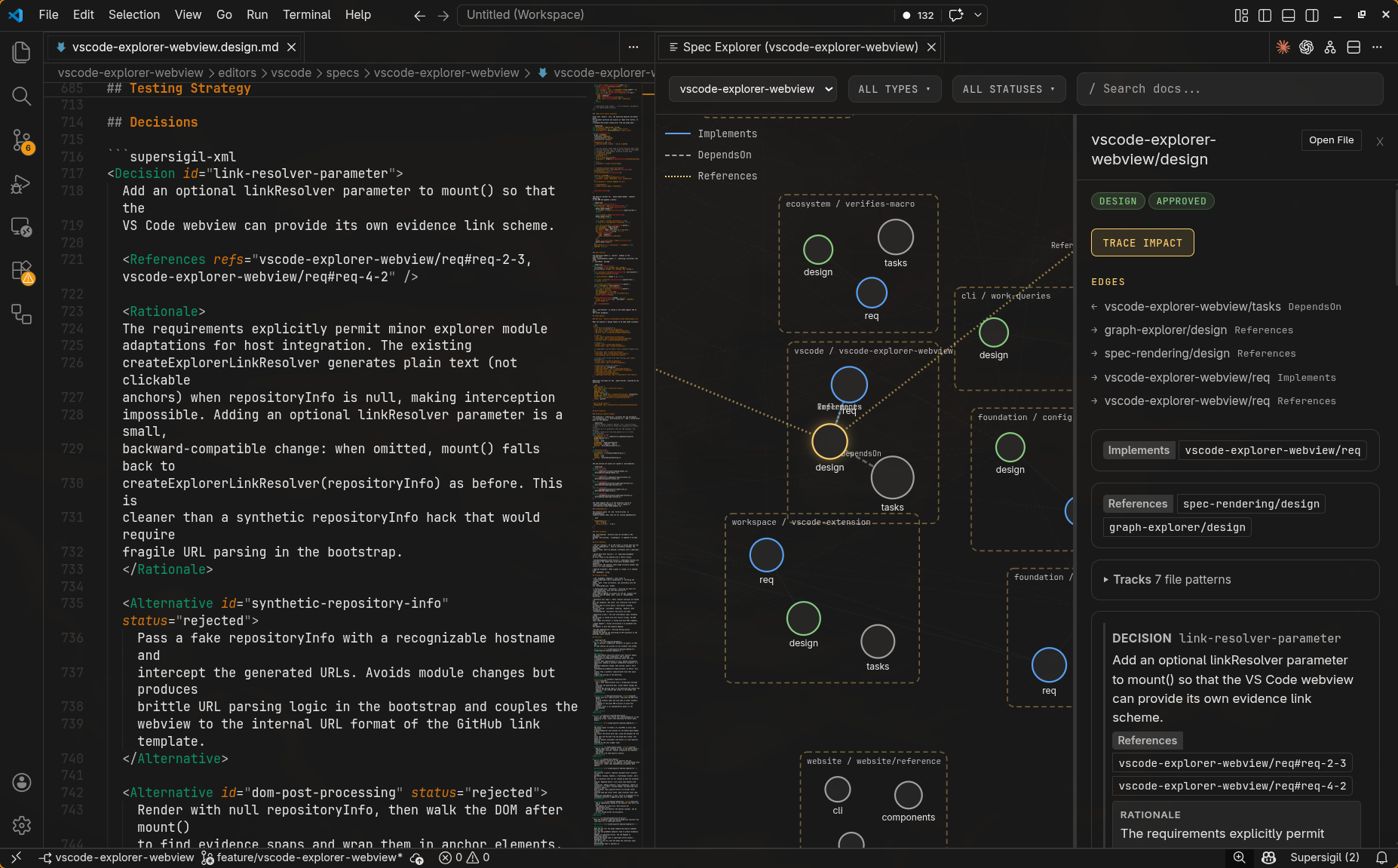
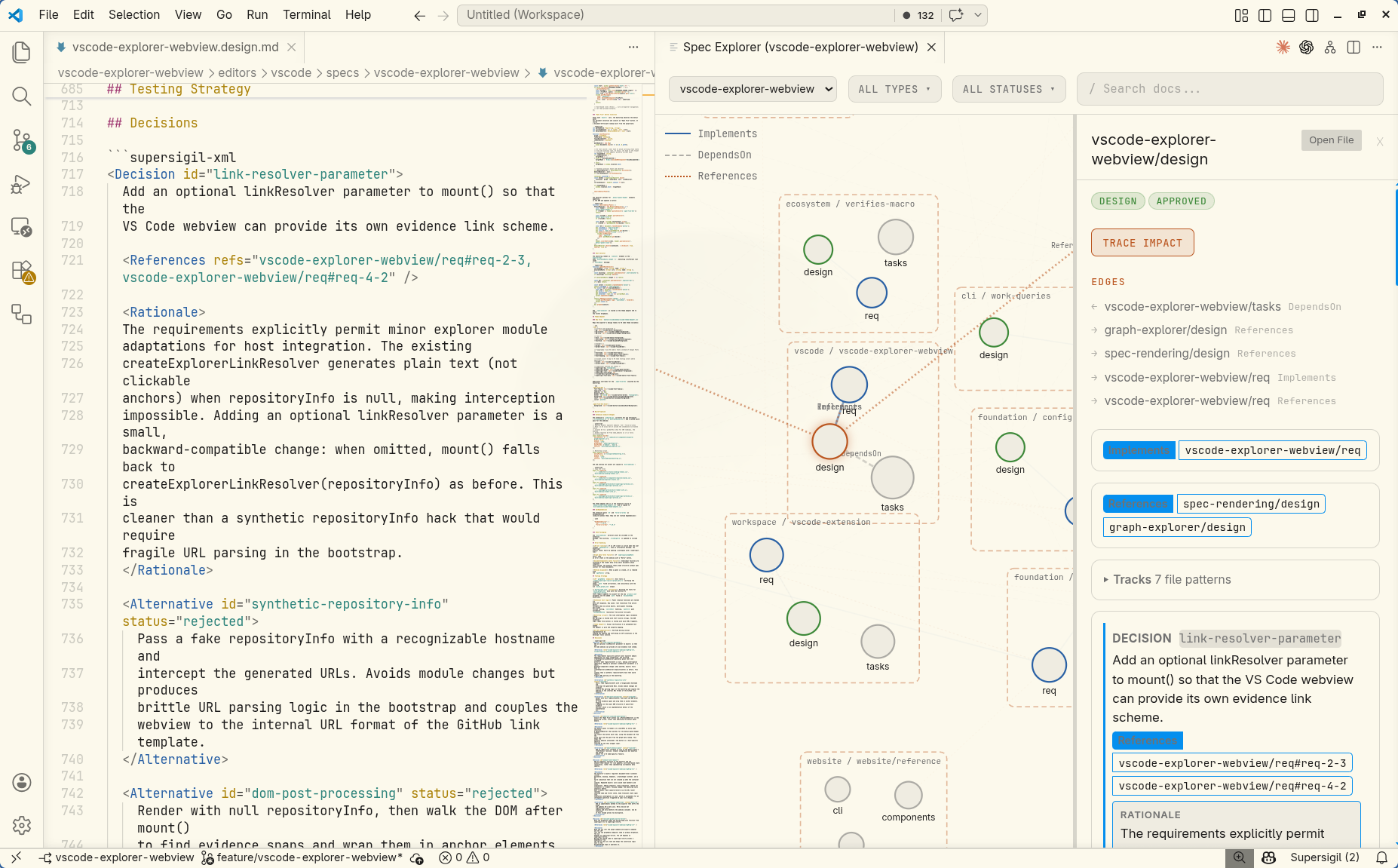
Navigate specs like code.
The full interactive graph explorer runs inside VS Code. Click a node to see its details, click "Open File" to jump to the source, or follow evidence links to the test that verifies a criterion. Specs and code share the same workspace — no context switch, no separate tool.
Who It's For
Built for engineering teams
shipping with AI assistance.
Engineering Teams
Keep requirements, design intent, and verification in the repo. Teams get one contract layer that survives pull requests, code review, and CI instead of drifting across tools.
AI Coding Workflows
Give agents precise scope, linked criteria, and machine-readable status. They can load the contract, make a change, and run the same verification loop your team trusts.
Solo Maintainers
Start with one spec file and one verification loop. Supersigil scales up without changing the basic workflow: write a Markdown contract, link evidence, and run verify.
Let's build verifiable software.
See the first verification loop in a few minutes, then branch into agents, CI, or deeper authoring.